Intrinsic AI for Industry Challenge - Robot Learning Pipeline
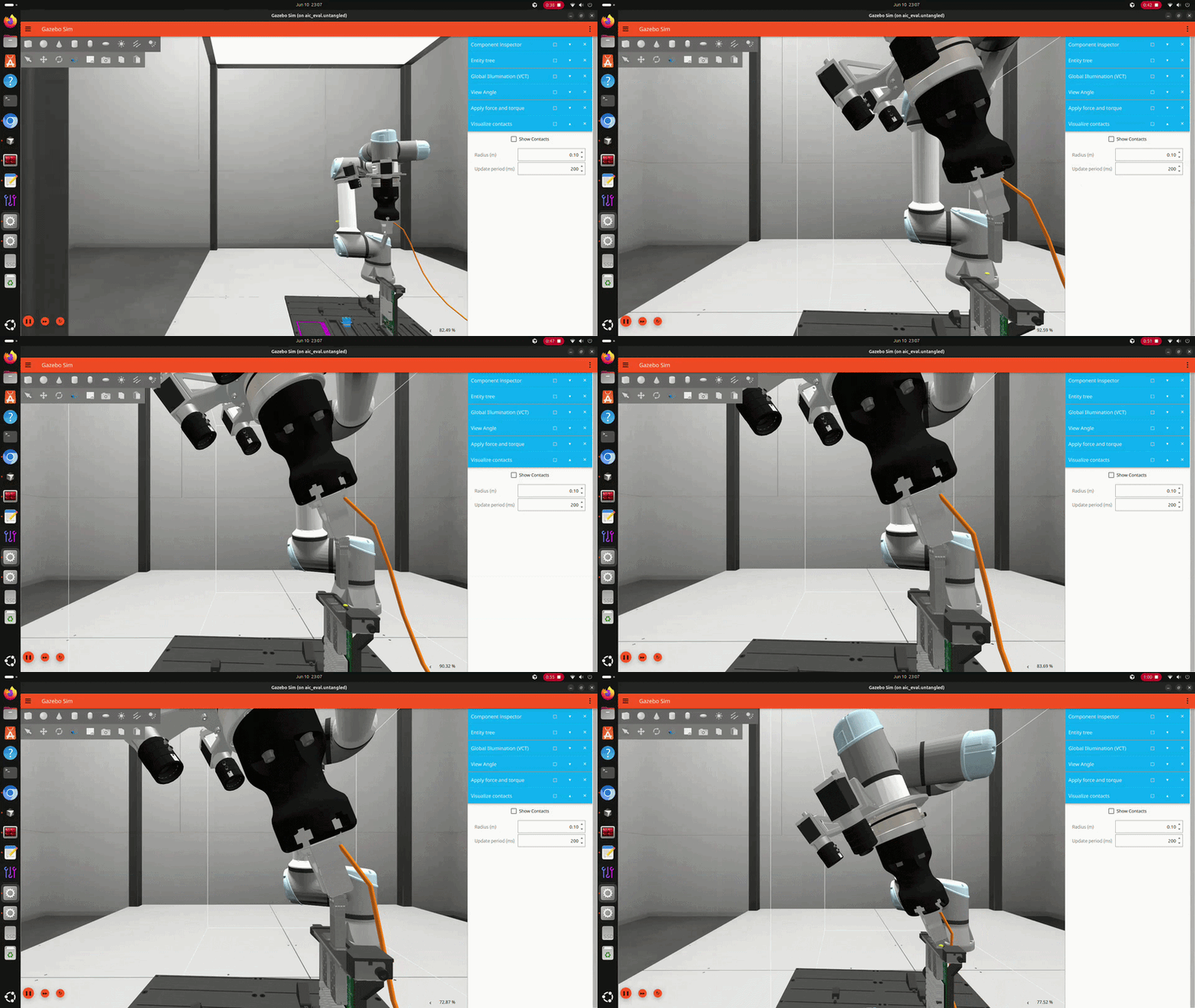
This project was built for the Intrinsic AI for Industry Challenge, an open competition for developers and roboticists tackling high-impact problems in robotics and manufacturing. Our team trained a robot to autonomously insert cable connectors (SFP and SC plugs) into randomized ports on a task board, a task demanding sub-millimeter precision, contact-aware behavior, and generalization across varied environments. The stack combined ROS 2, Gazebo simulation, and a custom LeRobot-based data collection and training pipeline.
Code: aic — data_collection_pipeline_package
Task Overview
The challenge required an autonomous policy to insert cable connectors into randomized ports on a task board in simulation, evaluated via an organizer-provided orchestration engine that handled simulation launching, robot control, and sensor fusion. Our submission was a containerized ROS 2 node implementing the cable-insertion policy, following the aic_model framework’s templated lifecycle-node structure.
Data Collection Pipeline
We built a custom LeRobot integration incorporating ROS 2 control, multi-camera observations, and a 26-dimensional robot state directly into the training and data collection pipeline.
To avoid the noise of manual teleoperation, we developed a passive observer pipeline that recorded ground-truth CheatCode actions as demonstrations, producing consistent, low-noise supervision at scale. Actions were encoded using an SE(3) relative pose representation (relative deltas rather than absolute targets), which improved robustness to randomized board positions.
The resulting dataset spanned hundreds of demonstrations and approximately 363,000 frames, with automated tooling for curation.
Policy Training
Using the collected dataset, we trained Action Chunking Transformer (ACT) policies with multi-view camera observations and robot state as input for sequential manipulation.
Lessons Learned
- Simulation Fidelity — physics quality and rollout throughput directly affect learning outcomes.
- Data Quality Over Quantity — consistent demonstrations proved more valuable than additional episodes.
- Diversity Over Repetition — interleaving diverse environments improved generalization significantly.